Apotheosis
The Lost SymbolApotheosis is the idea of a human being becoming divine, a transformation that gives The Lost Symbol its central symbolic tension between human potential and godlike power. Robert Langdon explains it through ancient imagery and American monuments; Katherine Solomon later recasts it as a possibility grounded in the human mind. Mal’akh, by contrast, treats apotheosis as a personal transformation to be achieved through ritual. Across these versions, the concept is at once an emblem of promise and a warning about the desire to wield power without wisdom.
Definition and Ancient Wisdom
Langdon identifies apotheosis as the transformation of man into God, linking the word to ancient Greek roots for becoming and godhood. In his account, the concept belongs to the Ancient Mysteries: secret wisdom whose promise of extraordinary human capability helped make it both precious and dangerous. The historical record, as Langdon describes it, traces such knowledge from Mystery Schools in early Egypt into Renaissance Europe and then to an elite circle of scientists associated with the Royal Society and the Invisible College. He remains skeptical of claims that this tradition literally bestowed supernatural powers, but acknowledges the evidence that influential thinkers, including Isaac Newton, studied mystical subjects alongside scientific ones.
That history makes apotheosis more than a claim about an individual becoming divine. It also explains the secrecy surrounding the knowledge thought to enable transformation. In Langdon’s account of the legend, practitioners feared that powerful wisdom might do harm if it reached the uninitiated, and secret fraternities therefore guarded it. The Masonic Pyramid extends this logic into an American setting: its hidden contents are said to preserve the Ancient Mysteries until humanity is ready for their potential. Apotheosis is the promised end of that story, but concealment and preparation are presented as safeguards against its premature or destructive use.
The Capitol’s Public Image
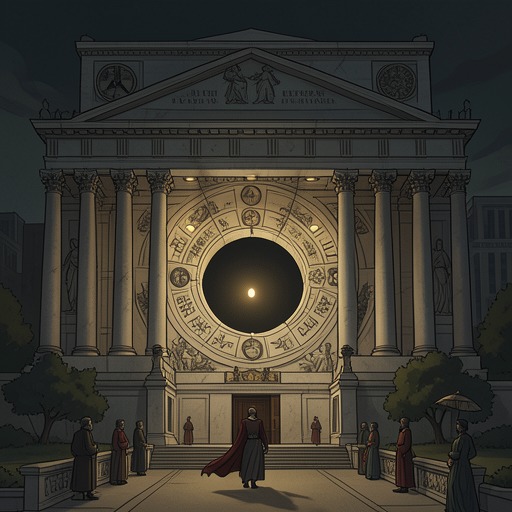
The Capitol Rotunda turns apotheosis into a conspicuous national image. Its center once had an opening through which visitors could see an eternal flame burning in the Capitol Crypt below. A federal Keeper of the Crypt tended the flame for fifty years, until political and religious disputes and smoke damage ended the practice. The opening was later covered; the four-pointed star compass embedded in the crypt floor remains a reminder of the flame and its intended illumination toward the four corners of the New World. Langdon presents the Rotunda’s earlier arrangement as an American echo of the Temple of Vesta, joining an idea of enlightenment to a literal fire beneath the room.
Above the Rotunda, Constantino Brumidi’s 4,664-square-foot fresco The Apotheosis of Washington, completed in 1865, makes the transformation explicit. George Washington appears in white robes, attended by thirteen maidens and ascending above mortal humanity. Around him, ancient gods present knowledge and technology to American inventors: Minerva inspires Benjamin Franklin, Robert Fulton, and Samuel Morse; Vulcan is associated with the steam engine; Neptune with the transatlantic cable; and Ceres with the McCormick reaper. The fresco puts scientific achievement inside a mythic framework, suggesting that knowledge enables feats that earlier generations might have regarded as divine.
The painting also becomes part of the immediate mystery surrounding Peter Solomon’s severed hand. Its gesture points upward, prompting Langdon and Inoue Sato to consider the fresco as a possible clue. Langdon insists that the gesture belongs to a wider symbolic tradition and signifies a mystical connection between humanity and God; it does not establish that a literal portal exists above them. The scene distinguishes a figurative gateway to transformation from a physical entrance, even as the Rotunda’s imagery makes the two difficult to separate. The painting’s scale and position turn apotheosis into a national emblem visible above lawmakers, while the pointing hand makes that emblem a clue in the present action.
Pyramid, Capstone, and Human Potential
The pyramid legend gives apotheosis a material form. In Langdon’s account, the Masons supposedly carried ancient wisdom from the Old World to America and concealed it in a fortress-like pyramid, crowned with a solid-gold capstone symbolizing the treasure within. The object found in the Capitol’s secret chamber initially seems to support the legend, but Langdon distinguishes the small, flat-topped stone from the imagined Masonic Pyramid. He identifies it instead as an Unfinished Pyramid, a sign that humanity’s ascent toward its full potential remains incomplete. On the one-dollar bill, the separate, hovering capstone similarly suggests work still to be done by both the nation and its people.
Warren Bellamy challenges Langdon’s literal objection that the legendary pyramid would have to be enormous. The description of a structure reaching high enough for God to touch it, Bellamy argues, can be read symbolically: what lies within reach of an enlightened human being is, in that sense, within God’s reach. He connects this interpretation to the biblical ideas that humanity was created in God’s image and that the kingdom of God is within. The exchange shifts the question from the pyramid’s dimensions to what human beings might become. Apotheosis is not necessarily a change in physical stature; it can name the realization of a divine potential already present in humanity.
Mind, Responsibility, and Ritual
Katherine develops that inward reading through Noetic Science, which she describes as the study of human thought. She argues that ancient texts explored the mind’s power and that modern science is beginning to investigate whether thought can affect physical reality. In her interpretation, the claim that humanity was created in God’s image concerns the mind rather than bodily resemblance: people may be creators because their minds participate in a creative power. The Apotheosis of Washington therefore appears to her not only as a record of national symbolism but as a prophecy of human spiritual maturity, with scientific inquiry into thought reconnecting modern knowledge to ancient ideas.
Katherine’s account makes transformation carry an ethical condition. If thought can influence the world, destructive intentions can matter as much as constructive ones; human beings must therefore take care with the power they seek to develop. The novel sets this responsibility against the older insistence that secret wisdom be protected from those who are not prepared to use it. Apotheosis consequently signifies possibility, not permission: expanded power makes judgment more consequential, rather than rendering it unnecessary.
Mal’akh embodies a radically different, ritualized pursuit of the same promise. In the chamber atop the House of the Temple, he writes the Lost Word inside the ouroboros on his scalp, using Peter Solomon’s blood and a crow’s feather. He experiences the act as completion and unity, believing that the inscription will prepare him to receive the unimaginable power promised by apotheosis. His ritual takes the language of transformation literally and makes the body itself an artifact. Set against Katherine’s account of human potential and its dangers, Mal’akh’s self-consecration reveals the concept’s darker edge: the desire to become divine can turn a guarded ideal into an obsessive attempt at personal supremacy.